
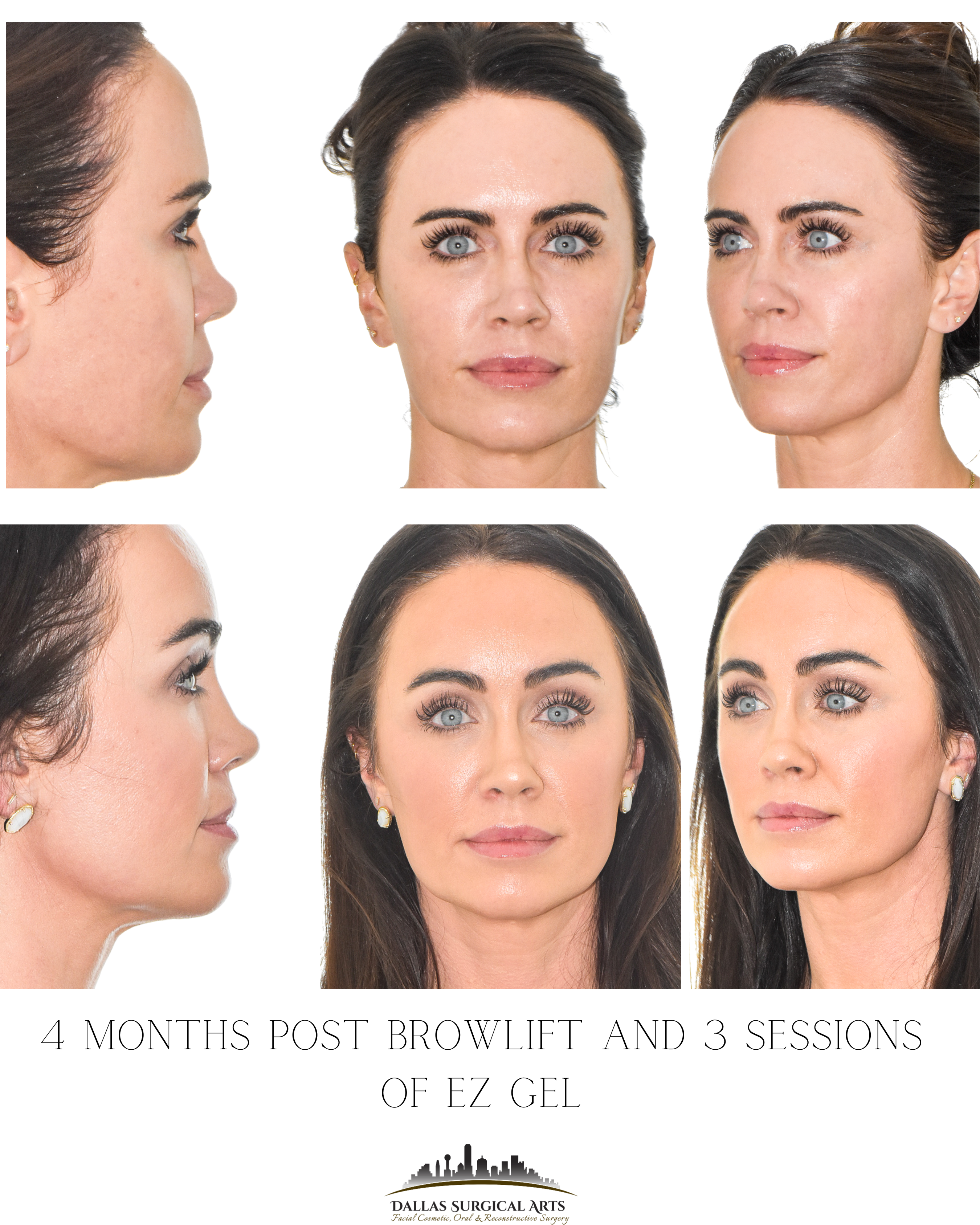
Changes in skin elasticity and gravity can cause the eyebrows to sit lower over time, creating forehead creases and a tired expression. To restore a smoother and more rested upper face, Dr. Sanovich may discuss brow lift surgery with you. Comparing the main types of brow lifts clarifies how each technique fits different hairlines and facial proportions.
What is a brow lift?
A brow lift, also called a forehead lift, raises the soft tissues of the forehead to reposition the eyebrows to a balanced height and soften horizontal forehead lines and frown creases.
Common types of brow lift techniques At Dallas Surgical Arts, board-certified surgeon Dr. Randy Sanovich primarily performs endoscopic and temporal brow lifts, tailoring incision placement to each patient's anatomy:
Endoscopic brow lift:"In my hands, the endoscopic brow lift is the most successful," Dr. Sanovich says. For this minimally invasive endoscopic brow lift, he places four small incisions behind the hairline, aligning with the medial (inner) brow and outer side on each half of the forehead. "We go in and free up the tissue underneath the periosteum to lift it off the bone down to just below the brow," he explains, carefully looking out for the facial nerve laterally plus the sensory supraorbital and supratrochlear nerves near the pupil and inner brow."Once that is all free, sutures or a suspending device lift up both the medial portion and the lateral portion to create the shape, avoiding that overdone, surprised look."
Temporal (lateral) brow lift and browpexy: When heaviness sits mainly along the outer eyebrow, a temporal brow lift or browpexy offers a targeted option. As Dr. Sanovich notes, "a small incision is made either right in the brow or in the temporal hairline near the temporal crest, allowing a small lift that focuses more on the lateral brow."
Hairline, coronal, and direct brow lifts: A hairline (trichophytic) brow lift places an incision across the front hairline so pulling the brow upward does not cause hairline recession, or can even lower a high forehead. However, Dr. Sanovich cautions that "even with a divided incision that is not straight, it can still leave a faint white line once healed that some people notice when wearing their hair back." Traditional ear-to-ear coronal brow lift incisions and direct above-the-brow excisions are less common today.
Recovery and Consultation
Recovery timelines vary by technique and individual healing. Mild swelling, forehead tightness, and bruising around the eyes typically ease within one to two weeks, while temporary scalp numbness fades gradually. Following Dr. Sanovich's specific aftercare plan, such as the endoscopic brow lift post-operative instructions at Dallas Surgical Arts can help support smooth healing.
During a consultation, Dr. Sanovich evaluates your brow symmetry, hairline, recovery timeline, and overall brow lift cost to build a personalized plan. Contact Dallas Surgical Arts to schedule your evaluation. This blog post is for informational purposes and is not a substitute for medical advice, diagnosis or treatment. Individual results and post-treatment recovery may vary.
- Visit Dallas Surgical Arts today and check out our special offers available this month!
- If you're interested in facial cosmetic surgery, reach out to our office in Dallas today.
- Learn more about Dallas cosmetic surgeon Dr. Randy Sanovich.
- Dr. Sanovich has been in D Magazine's Best for the past 10 years as a top Dallas surgeon!